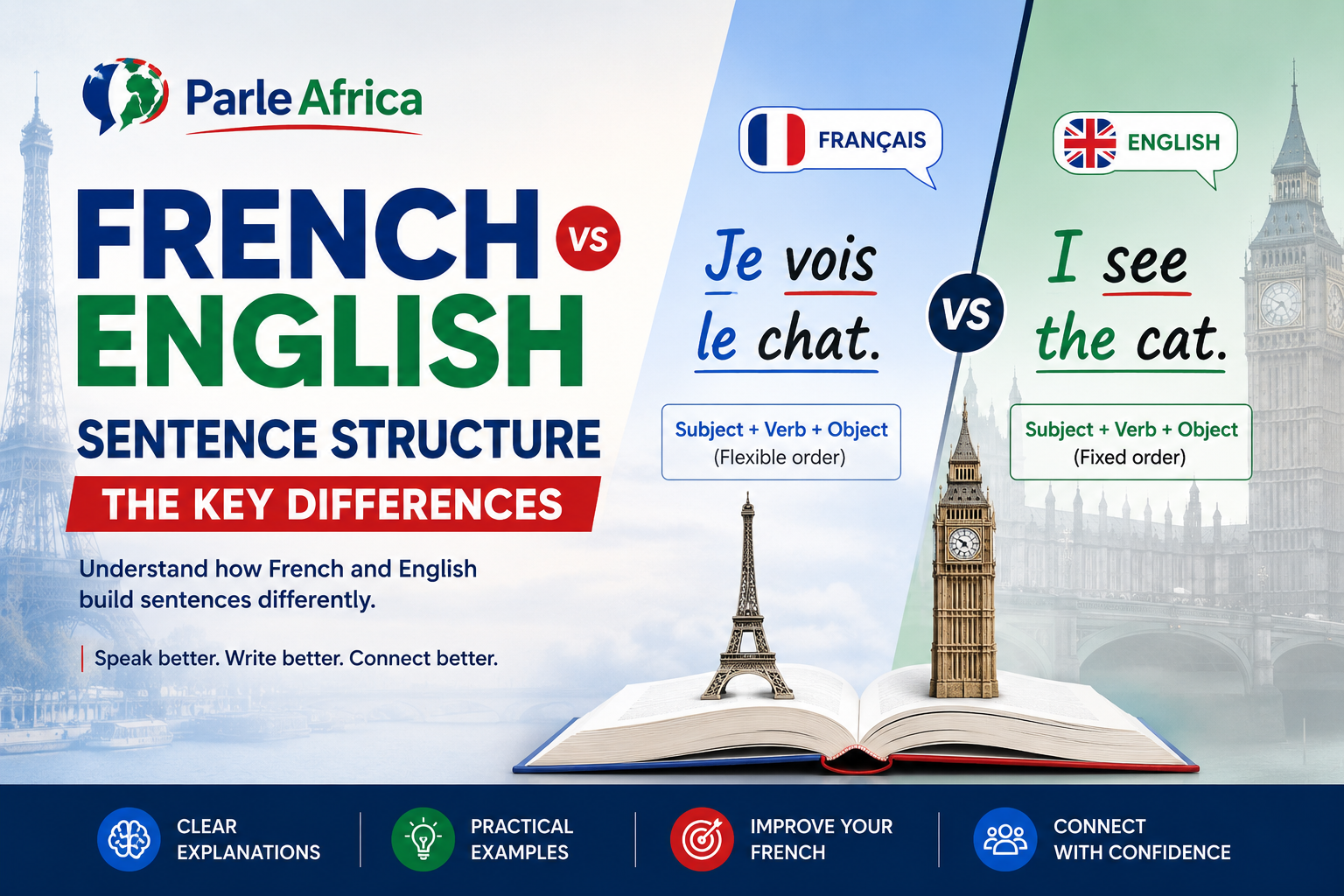
French vs English Sentence Structure — The Key Differences
Understanding how French sentences are built differently from English is the single biggest unlock for fluency. Here's a clear breakdown.

One of the biggest reasons English speakers struggle with French is that they try to translate word-for-word. It feels logical — you know what you want to say in English, so you build the same sentence in French. But French has its own internal logic, its own way of ordering ideas, and its own grammatical machinery. When you try to force English structure onto French words, the result is sentences that are technically made of French but don't actually work.
The good news is that once you understand the key structural differences, everything starts to click. You stop fighting the language and start working with it. This article breaks down the most important differences between French and English sentence structure — clearly, with examples you can use immediately.
1. Adjectives Come After Nouns (Usually)
In English, adjectives always come before the noun: "a red car", "a beautiful woman", "a difficult problem". In French, most adjectives come after the noun they describe.
- "a red car" → "une voiture rouge" (literally: a car red)
- "a difficult problem" → "un problème difficile" (literally: a problem difficult)
- "an interesting book" → "un livre intéressant" (literally: a book interesting)
However, a group of very common adjectives — mostly short, frequently used ones — come before the noun. A useful memory tool is the acronym BAGS (Beauty, Age, Goodness, Size):
- Beauty: une belle femme (a beautiful woman), un joli jardin (a pretty garden)
- Age: un vieux monsieur (an old gentleman), une jeune fille (a young girl)
- Goodness: un bon repas (a good meal), une mauvaise idée (a bad idea)
- Size: une petite maison (a small house), un grand homme (a great/tall man)
To complicate things slightly, some adjectives change meaning depending on whether they come before or after the noun. "Un grand homme" means a great man (figuratively). "Un homme grand" means a tall man (physically). "Mon ancien professeur" means my former teacher. "Un professeur ancien" means a very old teacher. These nuances come with exposure — don't try to memorise them all at once.
2. Negation Uses Two Words
In English, negation is simple: add "not" or use a contraction. "I speak" → "I don't speak." In French, negation traditionally wraps around the verb like a sandwich: "ne" before the verb, "pas" after it.
- "I don't speak French" → "Je ne parle pas français"
- "She doesn't eat meat" → "Elle ne mange pas de viande"
- "We don't know" → "Nous ne savons pas"
"Pas" is not the only negative word. French has a whole family of negation structures:
- ne... jamais — never: "Je ne mange jamais de sucre" (I never eat sugar)
- ne... rien — nothing: "Je ne vois rien" (I see nothing)
- ne... personne — nobody: "Je ne connais personne ici" (I know nobody here)
- ne... plus — no longer / not anymore: "Je ne fume plus" (I no longer smoke)
- ne... que — only: "Je n'ai que dix euros" (I only have ten euros)
In spoken French, the "ne" is very commonly dropped: "Je parle pas français", "Elle mange pas de viande". You'll hear this constantly in casual conversation. In writing and formal speech, always keep the "ne".
3. Questions Are Formed Three Different Ways
English forms questions by inverting the subject and auxiliary verb: "You are coming" → "Are you coming?" French has three distinct ways to form questions, each appropriate for a different register.
- Intonation (most casual): Keep the statement word order and simply raise your voice at the end. "Tu parles français ?" This is how most French people ask questions in everyday speech.
- Est-ce que (neutral): Add "est-ce que" at the beginning of the statement. "Est-ce que tu parles français ?" This works in both casual and semi-formal contexts and is the safest option for learners.
- Inversion (formal): Invert the subject pronoun and verb, joining them with a hyphen. "Parles-tu français ?" This is used in formal writing, official contexts, and polished speech. In everyday conversation, it can sound stiff.
For question words (who, what, where, when, why, how), the same three methods apply:
- "Where are you going?" → "Tu vas où ?" / "Où est-ce que tu vas ?" / "Où vas-tu ?"
- "What are you doing?" → "Tu fais quoi ?" / "Qu'est-ce que tu fais ?" / "Que fais-tu ?"
As a learner, master "est-ce que" first. It works everywhere and will never sound wrong.
4. Object Pronouns Come Before the Verb
This is one of the most disorienting differences for English speakers. In English, object pronouns come after the verb: "I see him", "She calls me", "We want it". In French, object pronouns come before the verb.
- "I see him" → "Je le vois" (literally: I him see)
- "She calls me" → "Elle m'appelle" (literally: She me calls)
- "I'm giving it to you" → "Je te le donne" (literally: I to-you it give)
When there are two object pronouns, they follow a specific order before the verb: me/te/se/nous/vous come before le/la/les, which come before lui/leur, which come before y, which comes before en.
In imperative (command) sentences, the rule flips: "Give it to me" → "Donne-le-moi" — the pronouns come after the verb, joined by hyphens. This exception trips up many learners who have just mastered the pre-verb rule.
The key is to practice these as fixed phrases rather than trying to construct them from rules in real time. "Je le vois", "Je t'appelle", "Donne-le-moi" — learn them as units.
5. Verb Conjugation Carries More Information
In English, verb conjugation is minimal. "I speak, you speak, he speaks, we speak, they speak" — only the third person singular changes. The verb itself tells you almost nothing about who is speaking.
In French, every pronoun has its own verb form, and they are all distinct (at least in writing):
- je parle — I speak
- tu parles — you speak
- il/elle parle — he/she speaks
- nous parlons — we speak
- vous parlez — you speak (formal/plural)
- ils/elles parlent — they speak
This richness means that in informal French, subject pronouns are sometimes dropped because the verb form makes the subject clear. More importantly, it means that getting the conjugation wrong changes the meaning of the sentence in ways that getting an English verb wrong doesn't.
The tenses also work differently. French has two common past tenses where English has one: the passé composé ("J'ai mangé" — I ate / I have eaten) for completed actions, and the imparfait ("Je mangeais" — I was eating / I used to eat) for ongoing or habitual past actions. Choosing the wrong one doesn't just sound odd — it changes what you're actually saying.
6. Possession Works Differently
English uses apostrophe-s to show possession: "Paul's book", "the teacher's pen". French doesn't have this construction at all. Instead, French uses "de" (of) and reverses the order.
- "Paul's book" → "le livre de Paul" (literally: the book of Paul)
- "The teacher's pen" → "le stylo du professeur" (literally: the pen of the teacher)
- "My friend's house" → "la maison de mon ami" (literally: the house of my friend)
Possessive adjectives (my, your, his, her) also agree with the gender of the noun being possessed — not the gender of the owner. "His book" and "her book" are both "son livre" because "livre" is masculine. "His car" and "her car" are both "sa voiture" because "voiture" is feminine. This is deeply counterintuitive for English speakers and requires deliberate practice.
Building the Mental Model
Understanding these structural differences won't make you fluent overnight. But it will do something more valuable: it will stop you from making the same foundational mistakes over and over. Every time you catch yourself trying to translate directly from English, you can pause, apply the correct French structure, and build the right habit.
The goal is not to think about these rules consciously every time you speak. The goal is to internalise them through enough practice that they become automatic. That takes time, exposure, and real conversation.
Build the mental model first. Then fill it with vocabulary. Then practice until the structure disappears into instinct. That is how fluency is built — not through memorisation, but through understanding followed by repetition.
The ParleAfrica community is the perfect place to put these structures into practice. Post in French. Make mistakes. Get feedback. Try again. The structure will come.
Did you enjoy this article?
Tap ❤️ to like or 🔥 to superlike
More articles



Practice what you just learned
Join the ParleAfrica community and speak French with real Africans.
Join for free