
7 French Mistakes Nigerians Make (And How to Fix Them)
From gender confusion to false cognates, these are the most common errors Nigerian French learners make — and exactly how to correct them.

Learning French as a Nigerian comes with a unique set of challenges. Our languages — Yoruba, Igbo, Hausa, Pidgin — shape the way we hear, process, and produce sounds. The way we structure sentences in our mother tongues bleeds into our French. The way we were taught French in secondary school — through grammar tables and rote memorisation — left most of us with a fear of the language rather than a love for it.
But here's the truth: most of the mistakes Nigerian French learners make are predictable. And because they're predictable, they're fixable. Here are the 7 most common errors — and exactly how to correct them.
1. Ignoring Gender (Le vs La)
In English, objects don't have gender. A table is just a table. A book is just a book. In French, every single noun is either masculine (le/un) or feminine (la/une) — and there's no completely logical rule for which is which. Many learners just guess — and get it wrong half the time, which causes errors that ripple through the entire sentence.
When you say "le table" instead of "la table", it's not just a small slip. It affects the adjectives, the pronouns, and the agreement of the whole sentence. Gender is the foundation of French grammar.
Fix: Never learn a noun in isolation. Always learn it with its article. Don't learn "table" — learn "la table". Don't learn "livre" — learn "le livre". Don't learn "problème" — learn "le problème". Treat the article as part of the word itself. When you encounter a new noun, say it aloud with its article three times. That repetition builds the correct pattern in your memory.
A useful shortcut: nouns ending in -tion, -sion, -ure, and -ette are almost always feminine. Nouns ending in -ment, -age, and -isme are almost always masculine. These patterns won't cover everything, but they'll help you make educated guesses.
2. Pronouncing Silent Letters
French spelling and French pronunciation are two very different things. The written form of French preserves letters that haven't been pronounced for centuries. This confuses learners who try to read French the way they read English — sounding out every letter.
"Vous parlez" — the final Z in "parlez" is silent. "Beaucoup" — the P is silent. "Ils mangent" — the ENT ending is completely silent. "Hôpital" — the H is silent. "Froid" — the D is silent. The list goes on and on.
The result? Learners who have studied French for years but sound unnatural because they're pronouncing letters that no French speaker would ever say.
Fix: Listen more than you read. Seriously — before you ever try to read a French word, hear it spoken first. Use audio resources, French YouTube channels, and the ParleAfrica community to train your ear. When you do read, remember these key rules: final consonants are usually silent (except C, R, F, L — think "CaReFuL"), the letter H is always silent, and verb endings like -ent are never pronounced.
3. Using "Je suis" for Age
This is one of the most universal mistakes among English-speaking French learners, and Nigerians are no exception. In English, we say "I am 25 years old." The verb is "to be" — so naturally, learners translate this as "Je suis 25 ans." It sounds logical. It is completely wrong.
French uses a fundamentally different concept for age. Where English says you are an age, French says you have an age. This isn't just a grammatical quirk — it reflects a different way of thinking about time and identity.
Fix: The correct form is "J'ai 25 ans" — literally "I have 25 years." Memorise this pattern immediately and never use "Je suis" for age again. The same logic applies to hunger and thirst: "J'ai faim" (I am hungry — literally "I have hunger") and "J'ai soif" (I am thirsty — literally "I have thirst"). French uses "avoir" (to have) in many places where English uses "to be".
4. Confusing "Tu" and "Vous"
Both "tu" and "vous" translate to "you" in English — but they are not interchangeable. This distinction doesn't exist in modern English, which is why it trips up so many learners. In French, using the wrong form isn't just grammatically incorrect — it can be socially offensive.
"Tu" is the informal singular "you" — used with friends, family, children, peers, and people you know well. "Vous" is the formal "you" — used with strangers, elders, authority figures, and in professional settings. "Vous" is also the plural "you" — used when addressing more than one person regardless of formality.
Using "tu" with your boss, a professor, or an older person you've just met signals disrespect — even if unintentional. In Francophone African cultures, where respect for elders is deeply embedded, this mistake can cause real offence.
Fix: Default to "vous" whenever you're unsure. It is always safer to be too formal than too casual. Switch to "tu" only when the other person explicitly invites it — in French, this is called "se tutoyer" and it's a social milestone in a relationship. When in doubt, vous it out.
5. False Cognates (Faux Amis)
French and English share thousands of words that look identical or very similar — and this is mostly a gift. Words like "information", "nation", "communication", "restaurant", and "hotel" mean exactly what you think they mean. But lurking among these helpful similarities are the faux amis — false friends — words that look familiar but mean something completely different.
These are dangerous precisely because they feel safe. You see a word that looks like English, you assume you know it, and you use it confidently — incorrectly.
Some of the most common faux amis for Nigerian learners:
- Sensible — means "sensitive" in French, not "sensible" (which is "raisonnable")
- Actuellement — means "currently" or "at the moment", not "actually" (which is "en fait")
- Librairie — means "bookshop", not "library" (which is "bibliothèque")
- Assister — means "to attend", not "to assist" (which is "aider")
- Rester — means "to stay", not "to rest" (which is "se reposer")
- Sympathique — means "nice" or "friendly", not "sympathetic" (which is "compatissant")
- Décevoir — means "to disappoint", not "to deceive" (which is "tromper")
Fix: Keep a dedicated list of faux amis and review it regularly. When you encounter a French word that looks like an English word, pause before assuming you know it. Look it up. The confidence that comes from recognising a word is exactly what makes faux amis so dangerous.
6. Forgetting Liaison
Liaison is one of the features that makes French sound so fluid and musical — and one of the features that most learners ignore entirely. Liaison is the linking of a final consonant (which is normally silent) to the vowel at the beginning of the next word.
"Les amis" — the S in "les" is normally silent, but before "amis" (which starts with a vowel), it becomes pronounced: "lez-amis". "Vous avez" becomes "vouz-avez". "Ils ont" becomes "ilz-ont".
When learners skip liaison, their French sounds choppy and unnatural — like reading individual words rather than speaking a language. Native speakers use liaison automatically, without thinking. It's one of the clearest markers of fluency.
Fix: Practice phrases as complete units, not as sequences of individual words. "Les amis" is one sound, not two. The more you listen to native French speech — in films, music, podcasts, and conversations — the more naturally liaison will come. Don't try to memorise the rules of liaison mechanically; absorb them through exposure.
7. Direct Translation from Pidgin or English
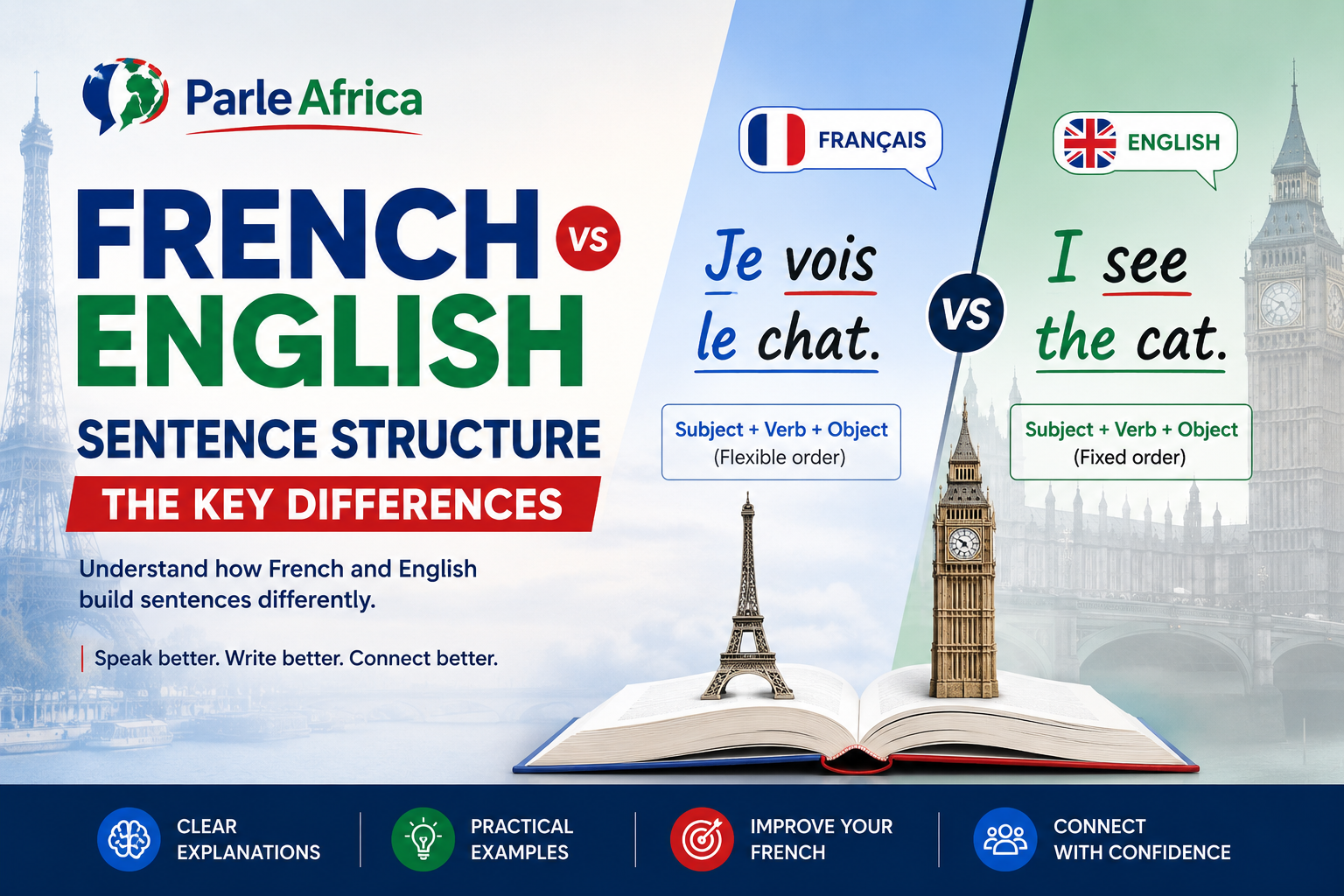
This is perhaps the most deeply rooted mistake, because it's not just a language habit — it's a thinking habit. When we don't know how to say something in French, we construct it in English or Pidgin first, then translate word by word. The result is French that is technically made of French words but structured like English.
"I want to go to the market" in Pidgin might be "I wan go market." A direct translation gives you "Je veux aller marché" — missing the essential preposition. The correct French is "Je veux aller au marché."
"She is not here" becomes "Elle est pas ici" — missing the "ne" of negation (even in casual speech, the structure matters). "I like it" becomes "J'aime le" — but French requires "Je l'aime" with the object pronoun before the verb.
Fix: Learn sentence patterns, not just vocabulary. Instead of learning the word "aller" (to go), learn the pattern "Je vais au/à la/aux..." (I'm going to the...). Instead of learning "vouloir" (to want), learn "Je voudrais..." (I would like...). Patterns give you the structure; vocabulary fills in the gaps. The more patterns you internalise, the less you'll need to translate from English.
The Bigger Picture
Every single one of these mistakes is normal. Every French learner — Nigerian, Ghanaian, British, American — makes them. The difference between learners who improve and learners who plateau is not talent. It is awareness and correction.
When you know what your common mistakes are, you can catch them in real time. You can build habits that prevent them. You can ask for feedback specifically on those areas. That is what deliberate practice looks like.
The ParleAfrica community exists precisely for this kind of learning — a space where you can make mistakes safely, get corrected kindly, and keep moving forward. Join the conversation. Your French will thank you.
Did you enjoy this article?
Tap ❤️ to like or 🔥 to superlike
More articles


Practice what you just learned
Join the ParleAfrica community and speak French with real Africans.
Join for free